
Future Sounds - Zukunftsmusik
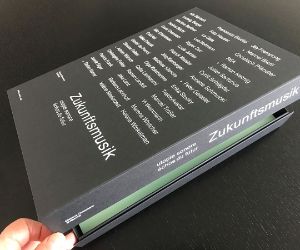
Musicians from all over Switzerland were invited to come up with music for an audience that has not even been born yet.
40 pieces of music that will be premiered in 100 years (2123)
Picture left: Pablo Diserens listening to glacial tha. Photo by Clément Coudeyre.
Picture right: fraufederer.ch
To mark the 100th anniversary of the copyright society SUISA, Swiss musicians have come up with 40 concepts and compositions that will be premiered 100 years after their creation. You can get a taste of this at the event on 16 April 2024 in Berne.
In the distant future of the year 2123, when SUISA celebrates its 200th birthday, sounds from an equally distant past will be heard. Quite a number of musicians from Switzerland have thought about how such music might sound. The result is a fascinating collaborative work by participants from all over Switzerland that will cause a sensation, and that not only in 100 years’ time. After months of preparatory work, there are now 40 concepts for such future sounds. They will be presented on 16 April 2024 at the Yehudi Menuhin Forum in Berne.
Escaping the zeitgeist
The ethnologist and curator Johannes Rühl developed this unique idea to mark the 100th anniversary of SUISA (Cooperative Society of Authors and Publishers of Music) last year. Together with the musician, cultural mediator and cultural manager Jennifer Jans and the social scientist, university lecturer and cultural mediator Peter Kraut, he has realised it, supported by SUISA, the FONDATION SUISA and other public and private sponsors.
Under the motto “Future sounds – escaping the zeitgeist”, musicians from all over Switzerland were invited to come up with music for an audience that has not even been born yet. Music that will be played for the first time in the year 2123, in a world we can barely imagine. Writing music that explicitly claims to be ahead of its time is a huge challenge.
Building bridges to an unknown future
This project aims to build a bridge between the creators of today’s music and future performers and their audiences, even though the two sides will never meet. The composers were free to decide whether they really wanted to create future sounds that would meet the expectations of future audiences. Or whether they simply prefer a musical signal from what will then be a deep past. Nobody knows how the audience will react to the music in 100 years’ time. We neither know their tastes nor their listening habits. We don’t even know whether they will have the same understanding of harmonics as we do today.
With the help of recognised Swiss curators, 40 outstanding Swiss musicians of all styles were selected, among them two winners of the Grand Prix of the Swiss Music Awards and fourteen winners of the General Swiss Music Awards. They were asked to submit a concept or idea for a new composition and record it on two A4 pages.
Conspicuous trends
Different elements of today’s understanding of music are represented in the project: New music, electronic music, jazz, pop and folk music. Cross-border and performative projects are also included, as well as installations. When reviewing the concepts, it is noticeable that voices are very often predetermined, and amateurs are often involved. Many projects have an explicit socio-political claim and some move in utopian spaces of human existence. Some seem like a message from a bygone era. Current crises are discussed, although nobody knows what the situation will be like in 100 years’ time. The climate, for example, is a topic, as are the melting glaciers, on several occasions. Faith in instrumental music is rather low, as is the confidence in electronically generated sounds, which probably don’t have much chance of survival.
All compositional and technical means for the live reproduction of music were allowed. It was up to the composers to decide which instrumental or technical means they wanted to use. By today’s standards, the compositions should be reproducible in 100 years. This is another reason why electronic music is practically ruled out. It was not permitted to record the work onto sound carriers or other media to play it back for the first time in 100 years. The concepts, drawings and sheet music that were submitted should be placed in the specified container in the archive and consist only of material that will survive 100 years without taking damage.
Intensive work is currently being carried out on five concepts. They were selected from the 40 to be performed in front of an audience in Bern on 16 April. But many other works are also discussed and briefly presented. Many of the musicians involved will be present at the event.
Public presentation of the projects, with some musical extracts:
16 April 2024 at the Yehudi Menuhin Forum Bern
Host: Desirée Meiser (Gare du Nord Basel)
With: Nik Bärtsch, Erika Stucky, Joy Frempong & Marcel Blatti (Oy), Hyper Duo, Patrick Frank, Simone Felber & Adrian Würsch, Martina Berther, Fritz Hauser, Ludwig Berger and Matthias Klenota.
Under lock and key for 100 years
After this event, the original documents will be handed over to the Swiss National Sound Archives in Lugano and stored in a sealed container for 100 years. Only acid-free paper has a chance of survival, handwritten notes in ink or ballpoint pens are the safest. Whether our handwriting can still be read in 100 years’ time is questionable, however. Perhaps there will be machines that can decipher our calligraphy. We do not know whether people will still be able to read music in 100 years’ time.
On the occasion of SUISA’s 200th anniversary in 2123, the treasure will be retrieved and, according to the plan, the 40 pieces from a distant time will be made audible for the first time. The National Sound Archives promised to ensure that the material will not be destroyed, stolen, altered or even forgotten for 100 years.
The project in the media
06 April 2024 in "Il Quotidiano" on the Ticino television station RSI (in Italian)
10 April 2024, 22:04, SRF1 a one-hour report on "Kulturplatz" (in German)
12 April 2024, 22:00, Radio SRF2 Kultur, in the series “Passage” by Bettina Mittelstrass (in German)
25 Sept. 2026, SRF1, news Morteratschgletscher GR: Wie klingt ein sterbender Gletscher? - Schweiz aktuell - Play SRF (in German)

One Minute of Escaping Air - Ludwig Berer is recording glacier sounds with hydrophones
Erlaubt waren alle kompositorischen und technischen Mittel zur Live-Reproduktion von Musik. Es lag in der Verantwortung der Komponistinnen und Komponisten, auf welche instrumentalen oder technischen Mittel sie zurückgreifen wollen. Die Kompositionen sollten nach heutiger Massgabe in 100 Jahren reproduzierbar sein. Auch deshalb scheidet elektronische Musik praktisch aus. Nicht gestattet war, das Werk auf Tonträger aufzuzeichnen, um es in 100 Jahren erstmals abzuspielen. Die eingereichten Konzepte, Zeichnungen und Noten sollten in dem vorgegebenen Behälter im Archiv Platz haben und nur aus Material bestehen, das 100 Jahre schadlos übersteht.
An fünf Konzepten wird zurzeit intensiv gearbeitet. Sie wurden unter den 40 ausgewählt, um ausschnittsweise am 16. April in Bern vor Publikum hörbar gemacht zu werden. Aber auch viele andere Arbeiten kommen zur Sprache und werden kurz präsentiert. Zahlreiche beteiligte Musikerinnen und Musiker werden am Anlass anwesend sein.
Öffentliche Präsentation der Projekte mit einigen Musikausschnitten am:
16. April 2024 im Yehudi Menuhin Forum Bern
Moderation: Desirée Meiser (Gare du Nord Basel)
Mit: Nik Bärtsch, Erika Stucky, Joy Frempong & Marcel Blatti (Oy), Hyper Duo, Patrick Frank, Simone Felber & Adrian Würsch, Martina Berther, Fritz Hauser, Ludwig Berger und Matthias Klenota.
Für 100 Jahre unter Verschluss
Nach dieser Veranstaltung werden die Original-Unterlagen der Schweizerischen Nationalphonothek in Lugano übergeben und für 100 Jahre in einem versiegelten Behälter eingelagert. Nur säurefreies Papier hat eine Überlebenschance, handschriftliche Aufzeichnungen mit Tinte oder Kugelschreiber sind am sichersten. Ob unsere Handschrift in 100 Jahren überhaupt noch gelesen werden kann, ist allerdings fraglich. Möglicherweise gibt es dann Maschinen, die unsere Kalligraphie entziffern. Ob die Menschen in 100 Jahren noch Noten lesen können, wissen wir nicht.
Zum 200-jährigen Bestehen der SUISA im Jahr 2123 wird der Schatz dann gehoben und, so der Plan, die 40 Stücke aus einer fernen Zeit zum ersten Mal hörbar gemacht. Die Nationalphonothek hat das Versprechen abgegeben, für 100 Jahre sicherzustellen, dass das Material nicht zerstört, entwendet, verändert oder gar in Vergessenheit gerät.
Das Projekt in den Medien
06. April 2024: im "Il Quotidiano" des Tessiner Fernsehens RSI
10. April 2024: SRF1, Reportage auf «Kulturplatz»
12. April 2024: Radio SRF2 Kultur in der Reihe «Passage»
25. Sept. 2026: SRF 1, News "Morteratschgletscher: Wie klingt ein sterbender Gletscher"
On the term “future sounds”
The “Zukunftsmusik” project, or future sounds project, touches on diverse musical, philosophical and deeply subjective moments. We are actually very familiar with the idea of constantly creating and consuming something new. At the same time, the longing for the tried and tested and the familiar is inescapable.
In 1860, Richard Wagner published his famous pamphlet “Zukunftsmusik” (“Music of the Future”). In it, he expressed his view that it was not enough for music to be merely contemporary. Music had to be ahead of itself and call up styles from the future that were already sprouting.
Today, hardly anyone would proclaim such an aspiration or concept. Contemporary means nothing more than from the present for the present. Avant-garde claims to be ahead of its time. New music is not yet music of the future. Electronic music documents today’s technical possibilities. Science fiction projects our fantasies of the future into the present. All music created today is for an audience of today. This time it isn’t exactly that, because the person to whom this music is directed hasn’t even been born yet.